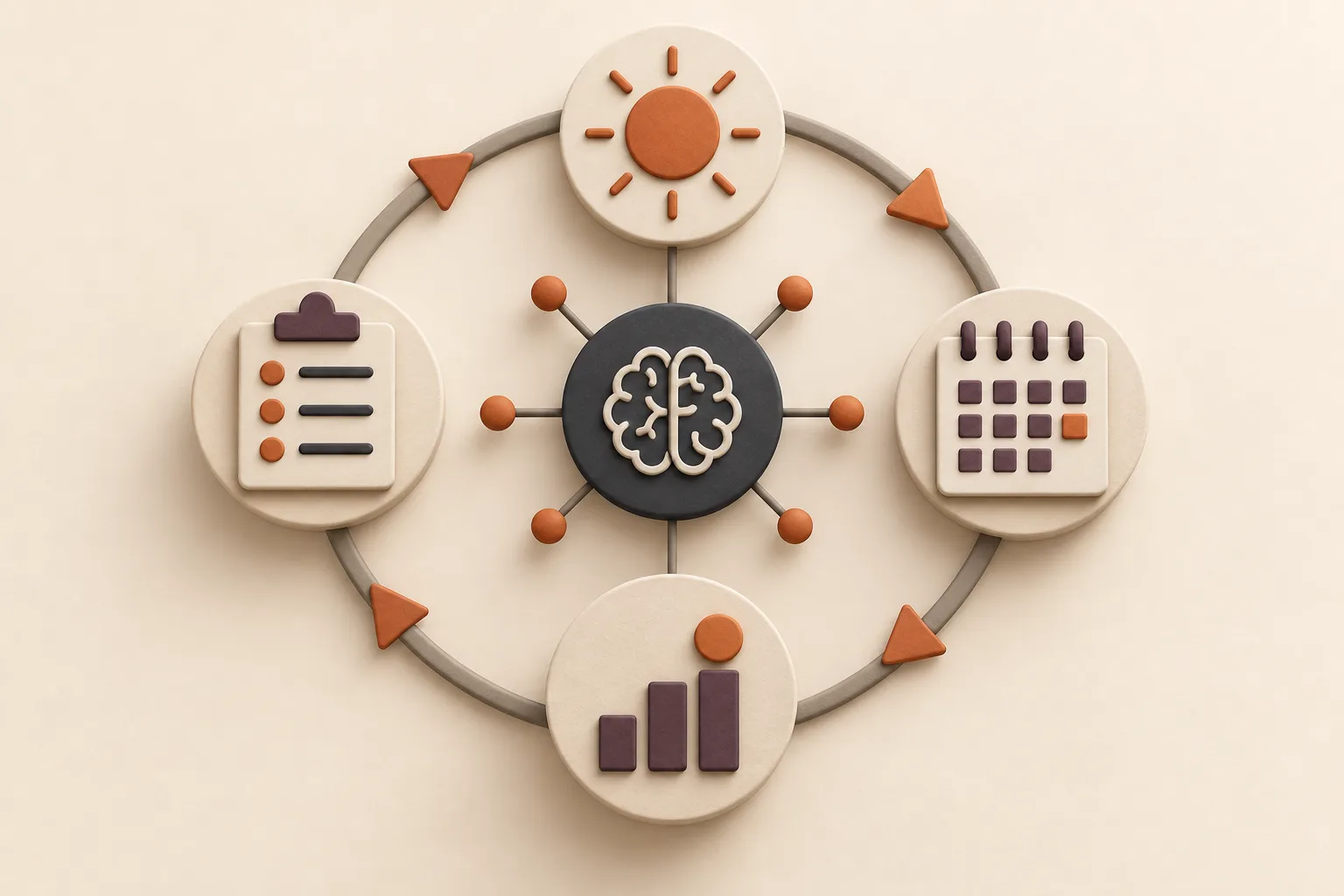
An AI operating cadence is a repeatable rhythm for producing and reviewing the artifacts a team already needs: standup digests, client updates, release briefs, planning inputs, and leadership views. The product is the cadence, not the chatbot.
A good cadence gives each workflow a trigger, an operator, a reviewer, and a moment on the calendar. It makes work easier to inspect across time zones without replacing the conversations that require live judgment.
Part 01 · Map the real rhythm
Map the real rhythm
Cadence is the product, not the chatbot
A workflow only becomes operational when it appears at the moment a team needs a decision or update. Treat the named rhythm and review loop as the product; the model is one component inside it.
One useful email a week
Get one workflow teardown a week.
A practical look at how a real repeated job becomes a reliable AI workflow — inputs, review points, and the failure modes to avoid.
By subscribing, you agree to receive Grokkit’s weekly workflow teardown. Unsubscribe anytime.
Daily, weekly, monthly jobs that already exist
List the recurring outputs the team already assembles: daily blockers, weekly commitments, monthly account or leadership updates, release decisions, and quarterly planning evidence. Those existing jobs are the first candidates.
Which cadence artifacts should become skills
Choose artifacts with stable inputs, a repeatable output, an identifiable reviewer, and enough frequency that manual reassembly causes drift. Use the first-workflow filters to reject one-off rituals.
Standup digest vs weekly leadership view
A standup digest highlights owners, blockers, and immediate changes; a leadership view explains trends, risks, decisions, and requests. Make them separate skills because the audience and definition of done differ.
Client update as a Thursday ritual
A client update should have a fixed source cutoff, client-safe language rules, an account-owner review, and a consistent send rhythm. A Thursday trigger gives the team time to correct missing evidence before the update matters.
Part 02 · Design the artifacts
Design the artifacts
Release train artifacts
Release cadence can include a readiness brief, change summary, known-risk list, and customer-facing notes. Keep the go/no-go decision distinct from the release-notes workflow so a polished summary cannot imply approval.
Quarterly planning inputs that stay evidence-backed
Planning inputs should preserve metrics, customer evidence, constraints, assumptions, and open questions. The workflow may organize options, but it should not convert a forecast or idea into an unqualified commitment.
Who invokes the skill vs who reviews it
The operator prepares sources and runs the job; the reviewer accepts the decision-critical artifact. These can be different people, and naming both prevents an automated ritual from becoming unowned.
Calendar design so the workflow has a home
Attach the workflow to a visible deadline, source cutoff, and review window in the calendar or project system. If the team cannot tell when it runs, the skill will be treated as optional background help.
Async-first teams vs meeting-heavy teams
Async teams need reliable written artifacts before the discussion; meeting-heavy teams can use them to shorten repetitive updates. Neither model removes the need for live conversation when trade-offs, conflict, or commitment require it.
Part 03 · Run and review the cadence
Run and review the cadence
Stopping status theater
A status artifact should surface changed facts, blockers, owners, decisions, and questions. If it merely restates activity, tighten the input contract and require a reviewer to ask what action the reader can take.
Shared standards across time zones
A stable output format lets people in different time zones see the same evidence, decisions, and unresolved work without reconstructing context from chat. Write timing and ownership rules into the workflow.
What still belongs in a live meeting
Keep conflict resolution, sensitive people decisions, ambiguous trade-offs, negotiation, and approval of major commitments in live discussion. A workflow can prepare the evidence and record the outcome, not replace accountability.
Rituals that die if the skill is annoying to run
If operators must hunt for files, repair the same sections, or wait on unclear inputs, the cadence will decay. Track friction and simplify the run path before adding more automation.
Cadence owner vs skill author
The skill author designs the package; the cadence owner is accountable for whether the ritual still creates useful decisions. They may be the same person early on, but the operating role must remain after handoff.
Part 04 · Scale the operating system
Scale the operating system
When a missed week means the skill failed
A missed run is a workflow failure when inputs existed but the trigger, routing, review, or output was too unclear to complete. Investigate it like a production miss rather than quietly skipping the artifact.
Combining recap, brief, and ops-review skills into a week
Use a meeting recap as structured input to account briefs and an operations review. Explicit handoffs prevent every weekly ritual from re-reading the same transcript.
Founder cadence in a 10-person company
A small company can begin with one weekly operating brief and one client or delivery ritual, both reviewed by the founder. The aim is fewer repeated founder reconstructions, not an elaborate AI control tower.
Department cadence in a 100-person company
A larger department needs shared input contracts, named cadence owners, versioned artifacts, and escalation paths between teams. Standardize the recurring outputs while allowing local judgment where work genuinely differs.
Mapping Grokkit workflows onto an existing operating rhythm
Grokkit starts with the rituals your team already runs, then packages the high-friction artifact with sources, checks, a reviewer, and a calendar-ready trigger. That keeps custom work attached to real operating behavior.