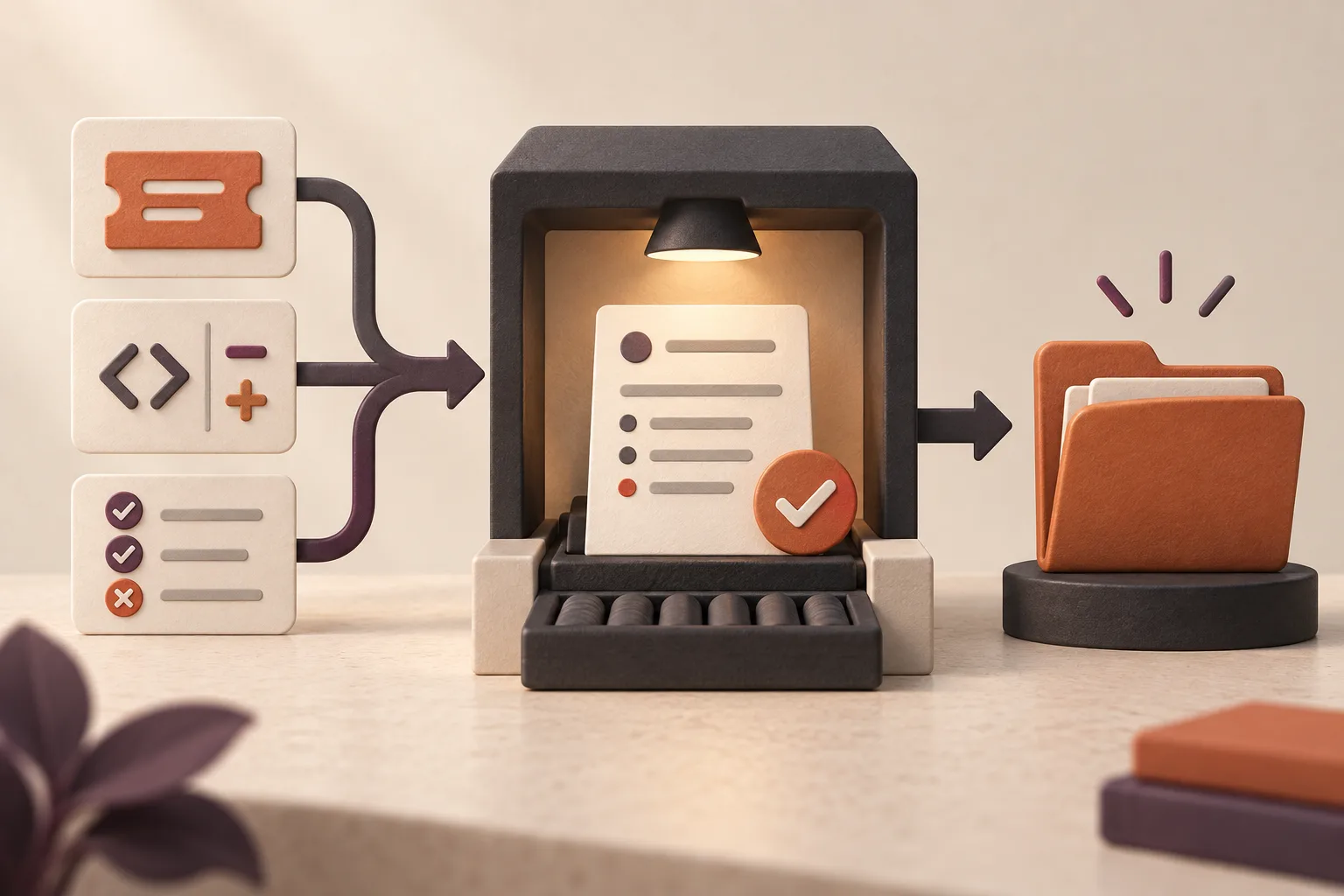
Engineering teams get value from AI when it appears near the ticket, diff, test output, and reviewer who already own the delivery decision. A review-ready brief can assemble evidence; it cannot replace the engineer responsible for approving change.
The pattern is consistent: keep shared job logic in a skill, adapt the installation to Cursor or another tool, and make risk, unknowns, and source references visible in the output.
Part 01 · Work where the evidence lives
Work where the evidence lives
Why engineering AI dies in chat sidebars
A chat sidebar loses the ticket, diff, test output, and review context that make engineering work verifiable. Put the workflow near those sources and produce an artifact the assigned reviewer can inspect.
One useful email a week
Get one workflow teardown a week.
A practical look at how a real repeated job becomes a reliable AI workflow — inputs, review points, and the failure modes to avoid.
By subscribing, you agree to receive Grokkit’s weekly workflow teardown. Unsubscribe anytime.
Ticket + test results to release-readiness brief
A release brief should state included work, test evidence, blockers, dependencies, known risks, missing checks, and the go/no-go owner. It can assemble the case; it must not approve the release.
Diff + context to review brief, not auto-merge
Use a review brief to summarize changed behavior, linked tickets, risk areas, tests, and open questions. It should help a reviewer focus their attention, never turn a generated summary into a silent merge.
Incident timeline from logs and notes
An incident workflow can order timestamped logs, tickets, chat notes, and decisions into an attributed timeline. It should preserve gaps and conflicting accounts rather than inventing a clean causal sequence.
PR description that names risk and unknowns
A PR description should identify intended change, evidence, test coverage, rollout or rollback considerations, and unanswered questions. A concise risk section is more valuable than a long generated explanation of code.
Part 02 · Design the engineering artifacts
Design the engineering artifacts
Design-review notes to decision log
Convert design-review notes into confirmed decisions, alternatives considered, owners, rationale, and open questions. Keep the source links so future engineers can distinguish an approved decision from a suggestion.
On-call handoff brief
An on-call handoff should list current impact, active investigation, evidence, mitigations, owner, next check, and escalation threshold. It is a continuity artifact, not an assertion that the incident is understood.
What must stay in Cursor vs what should be a shared skill
Keep repository-local diffs, tests, and code navigation in Cursor. Keep the reusable procedure, evidence rules, output schema, escalation policy, and test cases in the shared skill package.
Guardrails: no silent “LGTM”
Write a rule that no workflow may approve a diff, release, or security posture. It can identify evidence and risk, but a named human engineer remains the approver.
Evidence attached to failing tests and tickets
Each finding should point to the failing test, ticket, diff region, or log evidence that supports it. This makes a review brief actionable and stops plausible language from replacing diagnosis.
Part 03 · Protect human review
Protect human review
Reviewer is still the human engineer
The reviewer owns correctness, architecture, safety, and release judgment. The workflow reduces search and summary work so the reviewer spends attention on the parts that cannot be delegated.
Cross-over with product and ops skills
Engineering briefs can consume approved product context and feed release readiness or operations views. Define the handoff fields so a delivery summary does not become a source-free narrative.
Test suite from real messy tickets
Test with incomplete tickets, noisy failures, reverted changes, flaky tests, and conflicting notes. Engineering workflow quality is revealed by messy evidence, not a perfectly labeled demo issue.
Multi-language lint-and-explain is not the same job
Linting, code explanation, PR review, release readiness, and incident assembly have different inputs, checks, and reviewers. Split them into skills instead of creating one “engineering assistant” with an untestable boundary.
Security-sensitive diffs that must escalate
Changes involving authentication, authorization, secrets, payment, data exposure, or security controls should trigger a defined security review path. The workflow can flag context; it cannot certify the diff as safe.
Part 04 · Deploy across the delivery team
Deploy across the delivery team
Version the skill when the release process changes
When release evidence, approval policy, tools, or ownership changes, update the workflow and regression set together. Versioned workflow practice keeps old assumptions from silently surviving.
Team install: Cursor, Claude, Grok, ChatGPT
Install the shared procedure where each role works, then test the same cases in every supported environment. Tool-specific adapters are normal; the job’s definition of done should remain stable.
Metrics: time to go/no-go, missed blockers
Track time to review-ready release brief, missing-evidence findings, blockers surfaced before release, reviewer rebuilds, and false-clear signals. Raw code-generation speed is not the success measure.
Anti-pattern: agent that commits unreviewed work
An agent that commits or merges without a responsible engineer moves accountability into an opaque process. Keep the model inside a reviewable workflow with explicit approval points and traceable evidence.
Scoping a delivery workflow with Grokkit
Grokkit scopes one delivery artifact — such as release readiness, review brief, or incident handoff — around your tickets, tests, tools, reviewers, and risk boundaries before connecting adjacent jobs.