All case studies
Use case 01Revenue operations

AI CRM Lead Qualification

AI discovers, enriches, verifies, and scores accounts against a business-defined ICP, then syncs qualified prospects into the CRM for sales and marketing activation.

  • Human control
  • Existing systems
  • Scoped rollout
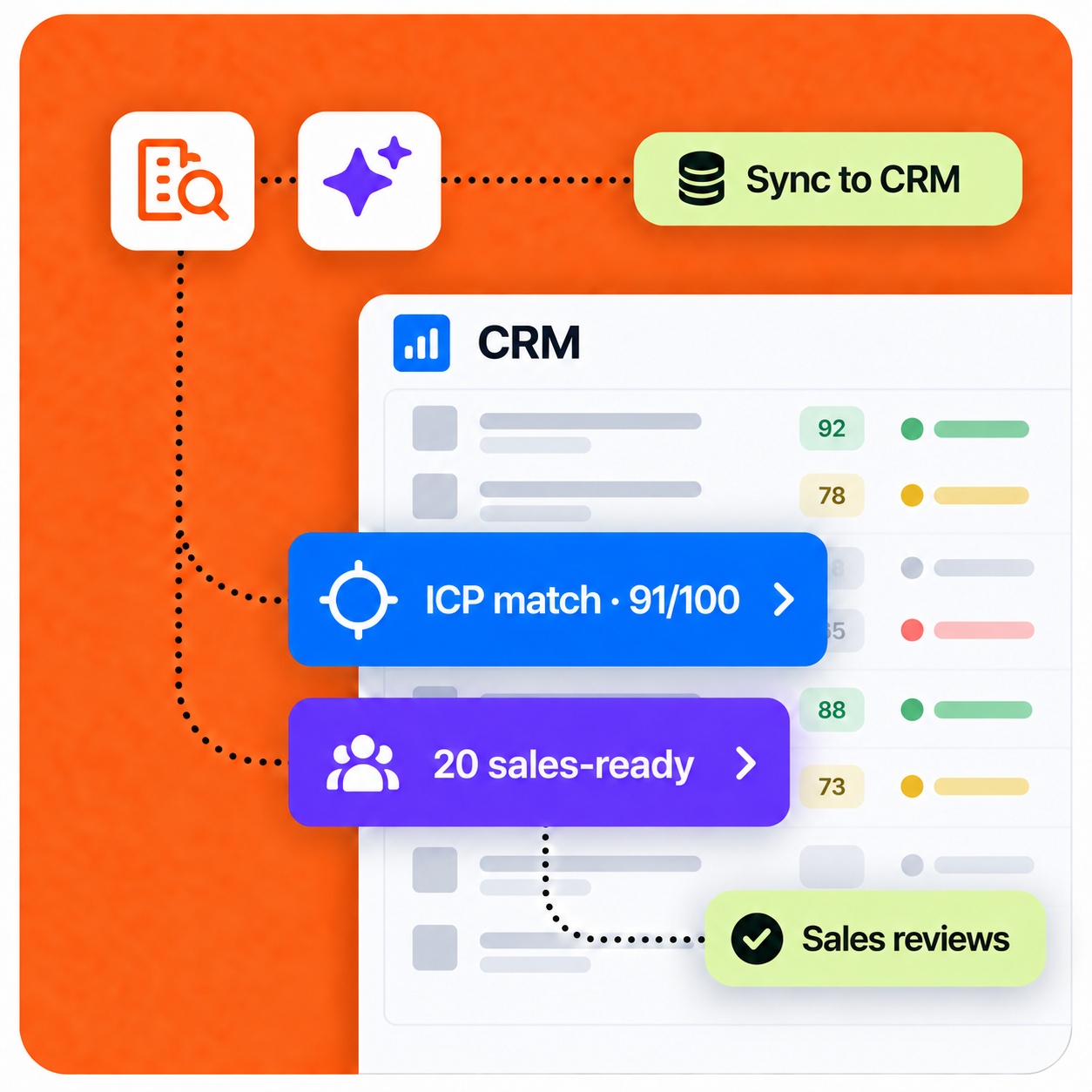
AI CRM lead qualification showing a 91 out of 100 ICP match and 20 sales-ready accounts before sales review

Implementation pattern

Designed for human review

Operating context

Designed around how a small team actually works.

A credible automation starts with the real workload, owners, systems, and approval points—not a generic AI promise.

Representative company setup

A 15-person B2B SaaS or services company has 2–5 sales and marketing employees running outbound, paid acquisition, and account-based marketing.

Example company

17-person B2B SaaS team

Sales team

3 salespeople

Weekly target

20 qualified accounts

The workflow

Every handoff, made visible.

The automation does not hide the process. It structures the repetitive work, surfaces exceptions, and hands decisions to the right person.

Complete sequence

8 defined steps

  1. 01

    Step 01

    Potential accounts are discovered

    The workflow collects companies and contacts from approved sources using the business’s defined Ideal Customer Profile.

    • Industry, company size, and location
    • Relevant job titles
    • Technology used
    • Funding and hiring activity
    • Company-specific buying signals
  2. 02

    Step 02

    Accounts are qualified against the ICP

    Each discovered company is checked against the business’s actual fit criteria before reaching sales.

    • B2B SaaS industry match
    • Target employee range
    • Target geography
    • Competing solution in use
    • Relevant department present
  3. 03

    Step 03

    Relevant contacts are identified

    The workflow prioritizes likely decision-makers instead of creating a long list of loosely related contacts.

    • VP Marketing
    • Head of Growth
    • Director of Demand Generation
    • Other ICP-specific decision-makers
  4. 04

    Step 04

    Records are enriched and verified

    Company and contact details are checked before anything enters the CRM, with uncertain fields clearly flagged.

    • Company and domain
    • Job title and contact information
    • Company size and industry
    • Existing CRM records
    • Incomplete or questionable data
  5. 05

    Step 05

    Leads are scored and prioritized

    ICP fit, buying signals, and contact quality determine the recommended next action.

    • High score → Sales outreach
    • ABM fit → Target-account list
    • Moderate fit → Marketing nurture
    • Incomplete data → Research queue
  6. 06

    Step 06

    Duplicates and recent activity are checked

    The workflow prevents duplicate records and avoids handing sales an account that is already being worked.

    • Existing company record
    • Existing contact record
    • Recent sales outreach
    • Related account ownership
  7. 07

    Step 07

    Qualified records reach the CRM

    Only prospects that pass the qualification rules are synced with the context needed for activation.

    • Account and contact
    • ICP score and lead source
    • Buying signals
    • Recommended segment
    • Sales-ready status
  8. 08

    Step 08

    Sales and marketing take action

    The CRM triggers an appropriate downstream workflow while new sources and high-value accounts can remain behind a human-review threshold.

    • High intent → Sales task
    • ABM account → Target list
    • Ad audience → Marketing segment
    • Lower intent → Nurture campaign
    • Incomplete data → Research queue

Control by design

The business defines qualification. AI applies the rules to messy data.

An AI score is a recommendation, not objective truth. New data sources, uncertain enrichment, and high-value accounts should remain reviewable, and contacts should not be automatically enrolled into outbound campaigns without appropriate controls.

Security & data handling

Defined inputs

The workflow is limited to the systems, data, and knowledge selected for the job.

Explicit approval

A person stays at the decision point for customer-facing, financial, or otherwise high-impact actions.

Measured autonomy

Low-risk steps expand only after the team can review quality, exceptions, and outcomes.

Under the hood

A connected workflow, not another isolated chatbot.

Each stage has a defined input and output, while the existing stack remains the source of operational context.

Workflow architecture

  1. 01Approved lead sources
  2. 02Account discovery
  3. 03ICP qualification
  4. 04Contact identification
  5. 05Enrichment and verification
  6. 06Lead scoring
  7. 07Duplicate check
  8. 08Qualified lead
  9. 09CRM or data warehouse
  10. 10Outbound, ads, or ABM

Possible integrations

  • Approved data providers
  • Website and company data
  • CRM
  • Data warehouse
  • Sales task system
  • Marketing automation
  • Advertising audiences

Concrete scenario

Twenty qualified accounts per week

Example input

Find US-based SaaS companies with 50–500 employees and an established marketing team.

This sequence illustrates the operating logic. It is not presented as a guaranteed result or an autonomous decision.

  1. 01Discover 150 potential accounts
  2. 02Filter out 90 poor-fit companies
  3. 03Enrich the remaining 60 accounts
  4. 04Remove 15 duplicates or existing accounts
  5. 05Score the remaining 45 against the ICP
  6. 06Identify 20 accounts above the qualification threshold
  7. 07Sync those accounts to the CRM and create priority sales tasks

Expected impact

What this workflow is designed to improve.

Actual results depend on workflow volume, data quality, system access, and team adoption. A responsible rollout establishes a baseline before measuring impact.

01

More sales-ready leads

02

Less manual prospect research

03

Cleaner CRM data

04

Faster activation across outbound, paid ads, and ABM

Build a similar workflow

Start with the process, systems, and decisions your team already understands.

We can map where AI helps, where a person should stay in control, and what success should be measured against.

Discuss this workflow

Next case study · 02

AI Customer Support Triage