All case studies
Use case 07Developer experience

Developer Documentation Maintenance

AI detects documentation affected by engineering changes and proposes targeted updates, release notes, and consistency fixes for developer review.

  • Human control
  • Existing systems
  • Scoped rollout
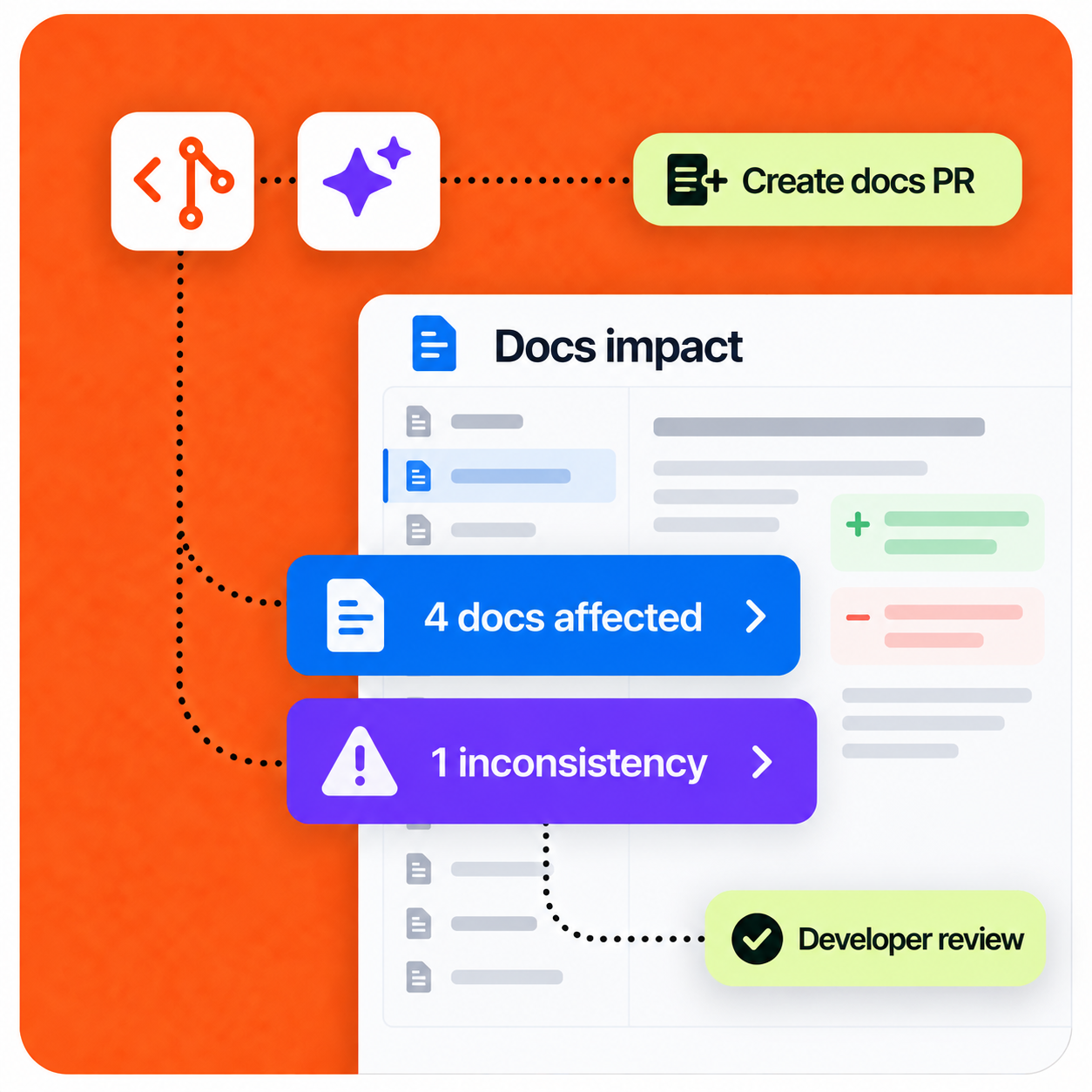
Developer documentation workflow showing four affected documents and one inconsistency before a documentation pull request is reviewed

Implementation pattern

Designed for human review

Operating context

Designed around how a small team actually works.

A credible automation starts with the real workload, owners, systems, and approval points—not a generic AI promise.

Representative company setup

A 15-person SaaS company has 5–7 developers maintaining API documentation, onboarding guides, internal technical documentation, and release notes.

Example company

16-person SaaS team

Product changes

15–20 per month

Engineering team

5–7 developers

The workflow

Every handoff, made visible.

The automation does not hide the process. It structures the repetitive work, surfaces exceptions, and hands decisions to the right person.

Complete sequence

8 defined steps

  1. 01

    Step 01

    Engineering work changes

    The workflow watches code and planning systems for changes that may affect technical documentation.

    • New or changed API endpoint
    • Configuration or environment variable
    • Database or schema change
    • Feature or bug fix
    • Breaking change or deprecation
  2. 02

    Step 02

    Documentation impact is identified

    The AI selects only the documents that may need attention instead of regenerating the entire documentation site.

    • Authentication guide → Update
    • API reference → Update
    • Getting-started guide → Potential update
    • Changelog → Add entry
    • Deployment guide → No change
  3. 03

    Step 03

    The code change is analyzed

    The PR description and relevant diff are compared with current documentation to understand the actual change.

    • New parameters and behavior
    • Configuration requirements
    • Deprecated functionality
    • Breaking changes
    • Existing documented behavior
  4. 04

    Step 04

    Targeted updates are proposed

    The workflow drafts changes for the affected pages while preserving the existing documentation structure.

    • API reference pages
    • Setup guides and tutorials
    • FAQs and troubleshooting
    • Internal knowledge-base pages
  5. 05

    Step 05

    Changelog entry is generated

    The same engineering change produces a standardized release-note entry, with breaking changes clearly flagged.

    • Added: OAuth 2.0 authentication support
    • Breaking change highlighted
    • Linked back to the source change
  6. 06

    Step 06

    Inconsistencies are checked

    Existing documentation is searched for statements that may now be outdated or contradictory.

    • authentication.md says API keys are required
    • Recent PR introduces OAuth authentication
    • Review recommended
  7. 07

    Step 07

    Developer reviews the proposal

    The workflow creates a documentation pull request rather than publishing directly.

    • Approve
    • Edit
    • Reject
    • Request additional changes
  8. 08

    Step 08

    Approved documentation is published

    Once the documentation PR is merged, approved updates reach the appropriate public and internal destinations.

    • Public documentation
    • API reference
    • Changelog
    • Internal knowledge base

Control by design

AI proposes documentation changes. Developers own technical accuracy.

Code does not always explain why a system behaves as it does, and a plausible draft can still be wrong. The workflow reduces documentation debt without removing developer review or directly publishing unverified content.

Security & data handling

Defined inputs

The workflow is limited to the systems, data, and knowledge selected for the job.

Explicit approval

A person stays at the decision point for customer-facing, financial, or otherwise high-impact actions.

Measured autonomy

Low-risk steps expand only after the team can review quality, exceptions, and outcomes.

Under the hood

A connected workflow, not another isolated chatbot.

Each stage has a defined input and output, while the existing stack remains the source of operational context.

Workflow architecture

  1. 01Code, PR, or ticket
  2. 02Change analysis
  3. 03Impact detection
  4. 04Existing docs retrieval
  5. 05Proposed updates
  6. 06Consistency check
  7. 07Release notes
  8. 08Developer review
  9. 09Documentation PR
  10. 10Publish

Possible integrations

  • GitHub or GitLab
  • Pull requests
  • Jira or Linear
  • Documentation platform
  • Release notes
  • Internal knowledge base

Concrete scenario

OAuth documentation update

Example input

PR #482 adds OAuth authentication to an API that was previously documented as requiring API keys.

This sequence illustrates the operating logic. It is not presented as a guaranteed result or an autonomous decision.

  1. 01Detect the API behavior change when the PR is merged
  2. 02Identify four potentially affected documents
  3. 03Compare the diff with current authentication guidance
  4. 04Draft targeted API and getting-started updates
  5. 05Generate a standardized changelog entry
  6. 06Flag the contradictory API-key-only statement
  7. 07Create a documentation PR for developer review

Expected impact

What this workflow is designed to improve.

Actual results depend on workflow volume, data quality, system access, and team adoption. A responsible rollout establishes a baseline before measuring impact.

01

Reduced documentation debt

02

Docs aligned with code changes

03

Less repetitive release-note writing

04

Outdated or contradictory guidance surfaced

Build a similar workflow

Start with the process, systems, and decisions your team already understands.

We can map where AI helps, where a person should stay in control, and what success should be measured against.

Discuss this workflow

Next case study · 01

AI CRM Lead Qualification